You can feel perfectly healthy and still have changes happening inside your body that have not caused symptoms yet.
That is one of the biggest reasons people begin researching full body scans.
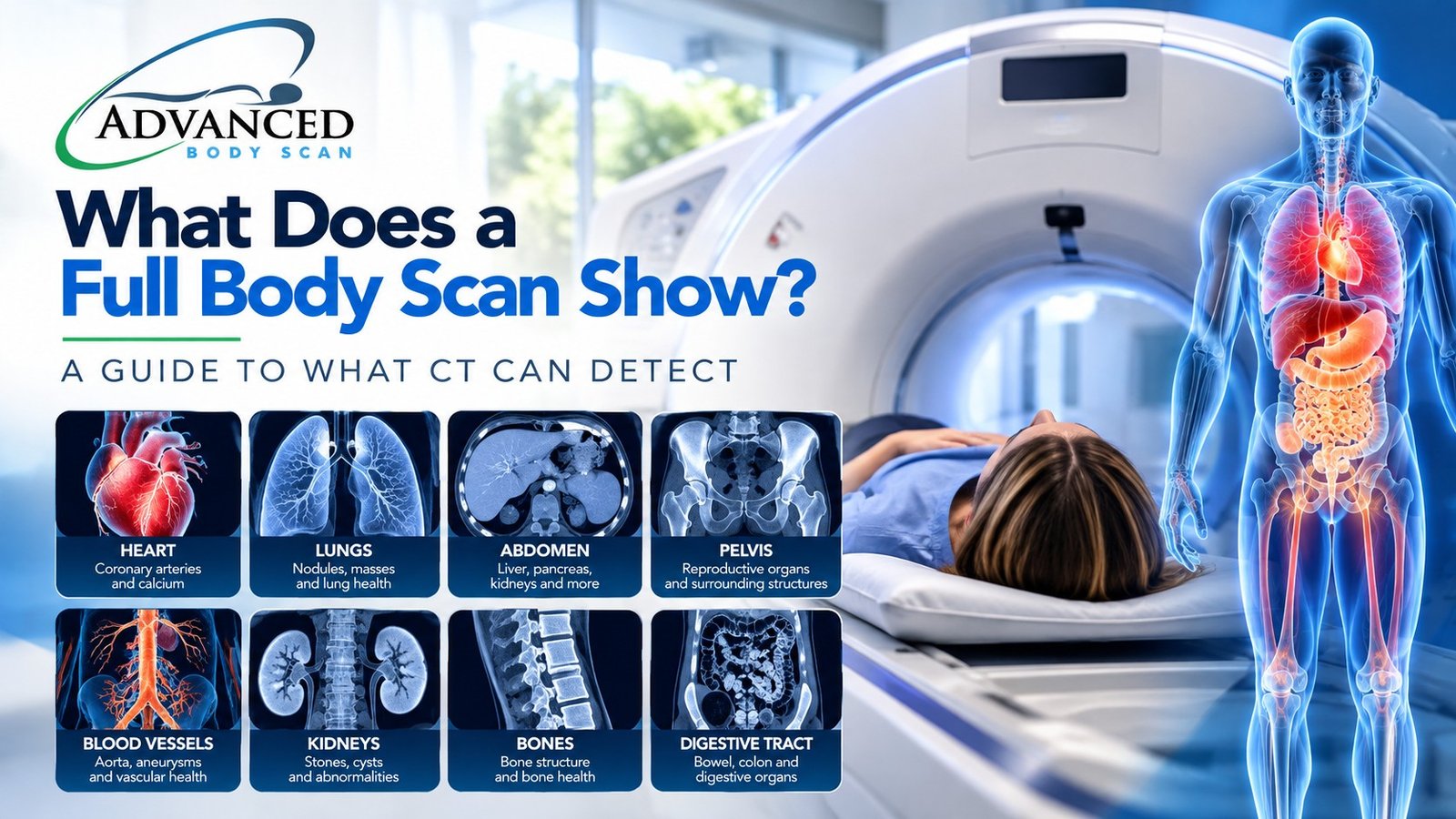
A full body CT scan creates detailed images of structures inside the body, giving physicians a closer look at the heart, lungs, major blood vessels, abdomen, pelvis, bones and many internal organs. Depending on the finding, CT imaging may reveal coronary calcium, lung nodules, aneurysms, masses, kidney stones and other abnormalities that deserve a closer look.
At Advanced Body Scan, advanced CT technology is used specifically to look for signs of potentially serious conditions before symptoms become the reason someone finally starts asking questions. The actual CT scan takes less than five minutes.
But what exactly can a full body scan show?
Key Takeaways
- A full body CT scan provides detailed images of many organs, blood vessels, bones and tissues inside the body.
- It can reveal findings associated with heart disease, lung disease, aneurysms, tumors and other conditions.
- Advanced Body Scan images more than 22 organ systems and lists more than 500 conditions that may potentially be identified through its scanning protocols.
- A scan can identify an abnormality, but imaging alone cannot always determine whether an abnormal finding is cancer.
- The Advanced Body Scan full body examination does not include the brain.
- The CT portion of an Advanced Body Scan visit takes less than five minutes.
- A full body scan is intended to provide additional information about your health. It does not replace your physician or other age and risk-appropriate medical testing.
What Is a Full Body CT Scan?
Computed tomography, better known as CT, creates detailed cross-sectional images of the inside of the body.
Think of it differently from a traditional photograph. Instead of seeing only the outside of something, CT produces many detailed image "slices" that physicians can review individually and reconstruct to better understand internal structures.
The American Cancer Society explains that CT images can show bones, organs and soft tissues in greater detail than a standard X-ray. CT can also help physicians identify the shape, size and location of an abnormal mass and its relationship to nearby structures.
At Advanced Body Scan, the purpose is advanced detection.
The question is not simply, "How do I feel today?"
It is, "What can we see today that I may not be able to feel?"
That distinction matters because many serious health conditions can develop quietly.
What Areas Does a Full Body Scan Look At?
Advanced Body Scan's full body CT examination evaluates areas from the neck through the pelvis, covering more than 22 organ systems.
It does not scan the brain.
Within the areas being examined, physicians can evaluate structures involving the:
- Heart
- Coronary arteries
- Lungs
- Aorta and other major blood vessels
- Liver
- Pancreas
- Kidneys
- Adrenal glands
- Gallbladder
- Spleen
- Bowel
- Pelvic organs
- Bones
- Soft tissues
The real value isn't simply that many areas are photographed. It is that a large amount of internal anatomy can be evaluated together rather than looking at only one isolated part of the body.
Can a Full Body Scan Show Heart Disease?
This is one of the most important reasons CT matters.
Heart disease remains the leading cause of death in the United States, so understanding cardiovascular risk deserves more than waiting for obvious symptoms.
CT can identify calcium within the coronary arteries. Coronary calcium is evidence of coronary atherosclerosis and can help provide additional information about a person's cardiovascular risk.
Cardiac CT can also provide detailed images of structures including the coronary arteries, heart chambers, valves and aorta.
This is also one of the major reasons Advanced Body Scan uses CT as the foundation of its advanced detection approach.
A person can exercise, go to work, travel, spend time with family and feel normal while coronary artery disease is developing.
Feeling fine is valuable.
Knowing more is better.
What Can a Full Body Scan Show in the Lungs?
CT is particularly valuable when examining the lungs.
Detailed CT imaging can reveal findings such as:
- Lung nodules
- Masses
- Areas of scarring
- Emphysematous changes
- Other structural abnormalities
CT can identify lung abnormalities with a high level of detail and can help show the size, shape and location of a suspicious finding.
That doesn't mean every lung nodule is cancer.
Far from it.
Lung nodules are common, and many turn out to be benign. What matters is knowing that a finding exists so an appropriate physician can determine whether observation, comparison imaging or additional testing is warranted.
Early information gives you options that ignorance cannot.
Can a Full Body Scan Detect Cancer?
This question deserves a careful answer.
CT can reveal masses, nodules, lesions and other abnormalities that may represent cancer, sometimes before symptoms have developed. However, a CT image alone cannot always prove that an abnormality is cancer.
Imaging tests can help find cancer in certain circumstances, locate masses and provide information about suspicious areas. However, imaging has limitations. Something that appears suspicious on imaging may eventually prove not to be cancer, and additional testing such as a biopsy may be necessary for a definitive diagnosis.
This is an important distinction.
The purpose of advanced detection isn't to turn every unusual finding into a frightening diagnosis.
It is to find information worth investigating.
Advanced Body Scan lists hundreds of conditions that its imaging protocols may identify across more than 22 organ systems.
When something unusual is found, the next step is understanding what it means and what, if anything, should happen next.
Can It Find an Aortic Aneurysm?
CT can provide detailed images of the aorta, the body's largest artery.
An aortic aneurysm occurs when part of the wall of the aorta becomes enlarged or weakened. The concern is that some aneurysms may develop without noticeable warning signs.
That makes finding an unexpected enlargement especially significant.
A scan may allow an abnormality involving the aorta to be identified and communicated to the patient so appropriate medical follow-up can occur.
This is a good example of what advanced detection is really about.
You are not getting scanned because you already know what is wrong.
You are looking because sometimes the important finding is the one you didn't know to look for.
What Else Can a CT Body Scan Find?
Not every finding is heart disease or cancer.
Advanced CT imaging may also identify abnormalities involving the kidneys, liver, pancreas, gallbladder, bones, adrenal glands, digestive tract and other structures.
Depending on the individual, findings could include things such as:
- Kidney stones
- Gallstones
- Liver lesions
- Pancreatic abnormalities
- Adrenal abnormalities
- Diverticular disease
- Hernias
- Bone abnormalities
- Soft tissue masses
- Enlarged lymph nodes
Some findings turn out to be minor. Others may lead to additional evaluation.
Both outcomes provide information you didn't have before.
What Doesn't a Full Body Scan Tell You?
No legitimate imaging center should pretend that one scan answers every medical question.
A full body CT scan does not replace:
- Your primary care physician
- Blood testing
- A mammogram when appropriate
- Cervical cancer screening
- A colonoscopy or other colorectal testing when recommended
- Skin examinations
- Diagnostic evaluation of new symptoms
- Other testing recommended because of your personal or family medical history
And again, the Advanced Body Scan full body CT examination does not include the brain.
A better way to think about advanced detection is as another layer of information.
Your laboratory results tell one story.
Your family history tells another.
Your physician's examination provides another.
Imaging can show structures inside your body that none of those can directly show.
Together, those pieces create context.
How Long Does a Full Body CT Scan Take?
This surprises many first-time patients.
The actual CT scan at Advanced Body Scan takes less than five minutes. Most patients spend approximately 20 minutes at the facility when check-in and related portions of the visit are included.
That speed is one reason CT is particularly well suited for examining multiple areas of the body.
Advanced Body Scan has also spent more than two decades focused on advanced detection and operates locations serving Oklahoma City, Dallas/Plano and Houston/Bellaire.
You can learn more about the technology, scanning process and conditions that may be identified directly from the experts at AdvancedBodyScan.com.
Who Should Consider Learning More About a Full Body Scan?
There isn't one universal profile.
People often begin researching advanced detection because they:
- Have a family history of heart disease or cancer
- Currently smoke or previously smoked
- Have cardiovascular risk factors
- Have reached an age where health risks are becoming more important
- Want more information about their health despite feeling well
- Have watched a parent, sibling or friend face an unexpected diagnosis
- Want to establish imaging information that can be compared over time
The important point is not to assume that everyone needs the exact same testing.
Your age, medical history, family history and individual risk factors matter.
That is why Advanced Body Scan offers consultations to help people understand which scan may fit their goals.
Knowing Before Symptoms Gives You Something Valuable: Time
Most of us are conditioned to think about healthcare after something hurts.
A strange pain appears.
Breathing becomes harder.
Something doesn't feel right.
Then we investigate.
Advanced detection asks a different question:
What if we looked before your body demanded our attention?
A full body CT scan cannot predict the future and it cannot guarantee that every disease will be found.
What it can do is provide a detailed look at many important structures inside your body right now.
Sometimes everything looks reassuring.
Sometimes a scan finds something worth watching.
And sometimes it identifies something that needs prompt medical attention.
All three outcomes begin with information.
For more than 20 years, Advanced Body Scan has focused on helping people gain that information through advanced imaging and early detection.
To learn more about what is included in a full body scan, visit AdvancedBodyScan.com and review the Full Body Scan information directly from the Advanced Body Scan team.
Frequently Asked Questions
What does a full body CT scan show?
A full body CT scan can provide detailed images of the heart, lungs, major blood vessels, abdominal organs, pelvic structures, bones and soft tissues. It may identify abnormalities including coronary calcium, lung nodules, aneurysms, masses, kidney stones and other findings.
Can a full body scan detect cancer?
CT can identify masses, lesions, nodules and other findings that may be suspicious for cancer. Imaging alone cannot always determine whether a finding is cancerous, so additional testing may be required.
Does a full body scan show the heart?
Yes. CT is particularly useful for cardiovascular imaging and can identify coronary artery calcium as well as provide information about other heart and blood vessel structures.
Does a full body scan show the lungs?
Yes. CT provides detailed images of the lungs and may identify nodules, masses, emphysematous changes, scarring and other abnormalities.
Does the Advanced Body Scan full body scan include the brain?
No. Advanced Body Scan's full body CT examination does not include the brain. Advanced Body Scan offers separate imaging options when brain imaging is appropriate.
How long does an Advanced Body Scan take?
The actual CT scan takes less than five minutes. The total appointment takes longer because of check-in and other parts of the visit.
Can a full body CT scan replace my annual physical?
No. A body scan provides imaging information and should complement, not replace, your primary care physician, laboratory work and other recommended health screenings.
Where can I get an Advanced Body Scan?
Advanced Body Scan operates centers serving Oklahoma City, Oklahoma; Dallas/Plano, Texas; and Houston/Bellaire, Texas. Visit AdvancedBodyScan.com for current location, consultation and scheduling information.